Partfox — Manufacturer & Buyer Dashboard
Client
Partfox
Year
2025
Partfox matches buyers' manufacturing needs with the exact machine capability behind them, which means manufacturers and buyers use the platform for opposite reasons. Manufacturer and buyer profiles were redesigned to reflect that: two distinct dashboards, each surfacing what that user actually needs to act on.
Scope of Work

The issue of the before
Both profiles had grown outdated and frustrating to use, though the pain played out differently for each user.
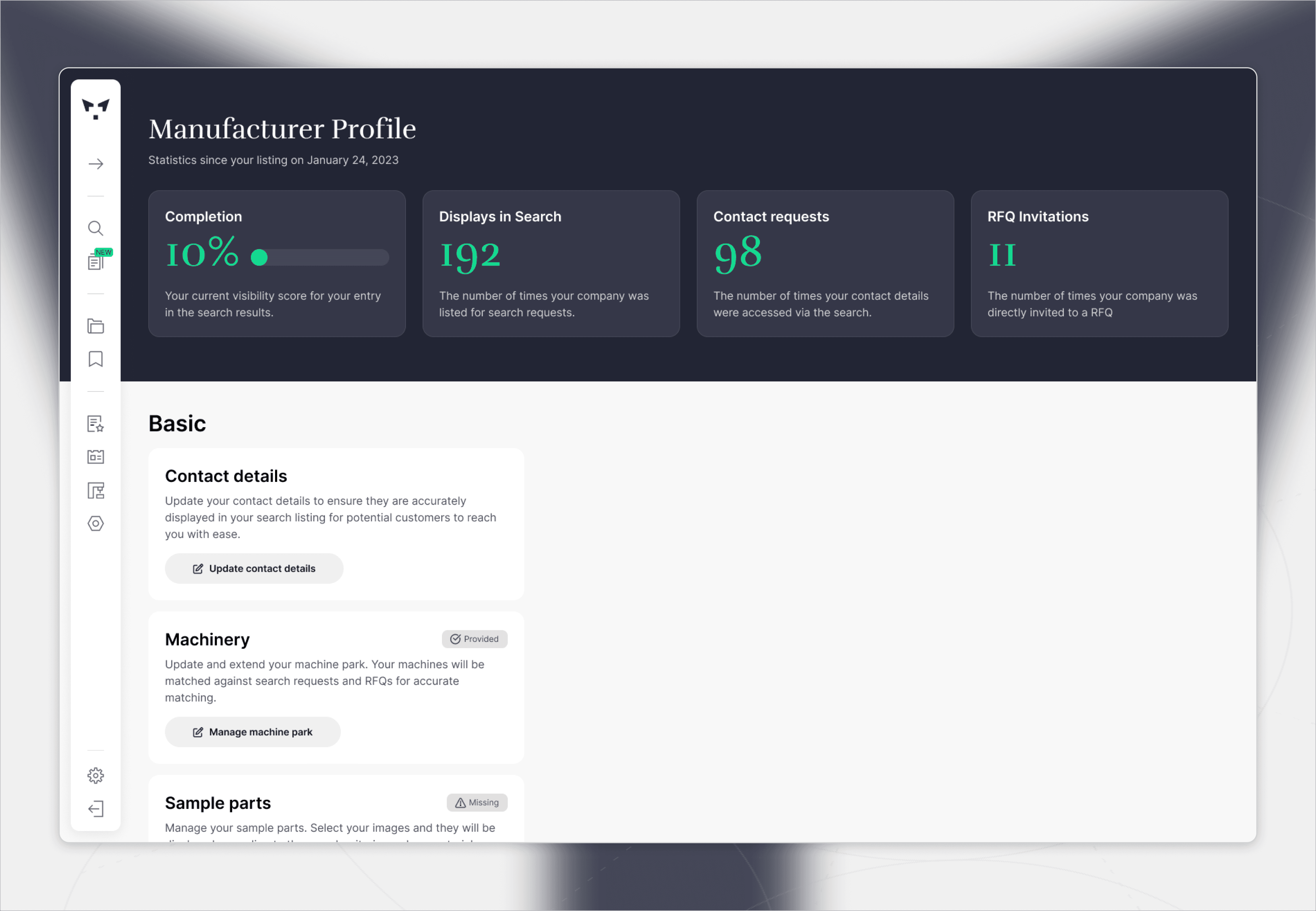
For Manufacturers: managing their own data was the frustration. Machinery, contact details, certifications, and performance stats each lived in a separate card, spread down a long page — updating or reviewing anything meant hunting across sections rather than seeing it in one place.
For Buyers: the frustration was a lack of visibility into activity. RFQs appeared as a flat list — title, status, date — with no sense of how manufacturers were actually responding, so gauging interest or engagement meant opening each request individually.

Buyer Dashboard — Solution
To find the real root of the problem, research combined three sources: Mixpanel data on buyers' top interaction points, a survey campaign built with marketing to surface pain points directly, and interviews with customer success and sales — the teams closest to buyer complaints.
All three pointed to the same gap: buyers had no single place to see how manufacturers were responding to their RFQs. The new dashboard fixes that — RFQ feedback with interest breakdowns (interested / pending / not interested), a manufacturer list organized by relationship, and top-matched manufacturers, all in one view.
Impact, 3 months post-launch:
+30% buyer engagement with the app
Became a sales talking point when pitching prospective buyers
Fewer support complaints from buyers about finding manufacturer RFQ feedback

Incomplete manufacturer data
Beyond usability, this fragmentation had a business consequence. Manufacturers frequently left profile data incomplete — and an incomplete profile meant poor positioning in the platform's search engine, making that manufacturer effectively invisible to buyers searching for their exact capability.
Caption: First login (or incomplete profile) now leads with a guided checklist — "Just 6 more steps to get listed" — turning an empty state into a direct nudge toward the data that drives search visibility.

First fix: prompting completion
The first problem addressed was this visibility gap. After registration — or whenever a profile is incomplete — the manufacturer is now pushed to complete their data before anything else.

Not Every Widget Survives
Reaching this layout meant designing and testing far more widgets than made the cut — Profile Strength, Visibility Score, RFQ status cards, and profile-completion nudges were each iterated on individually before approval. The result is a set of modular widgets, not one fixed layout, so performance data, RFQ activity, and completion prompts can coexist without competing for attention.

